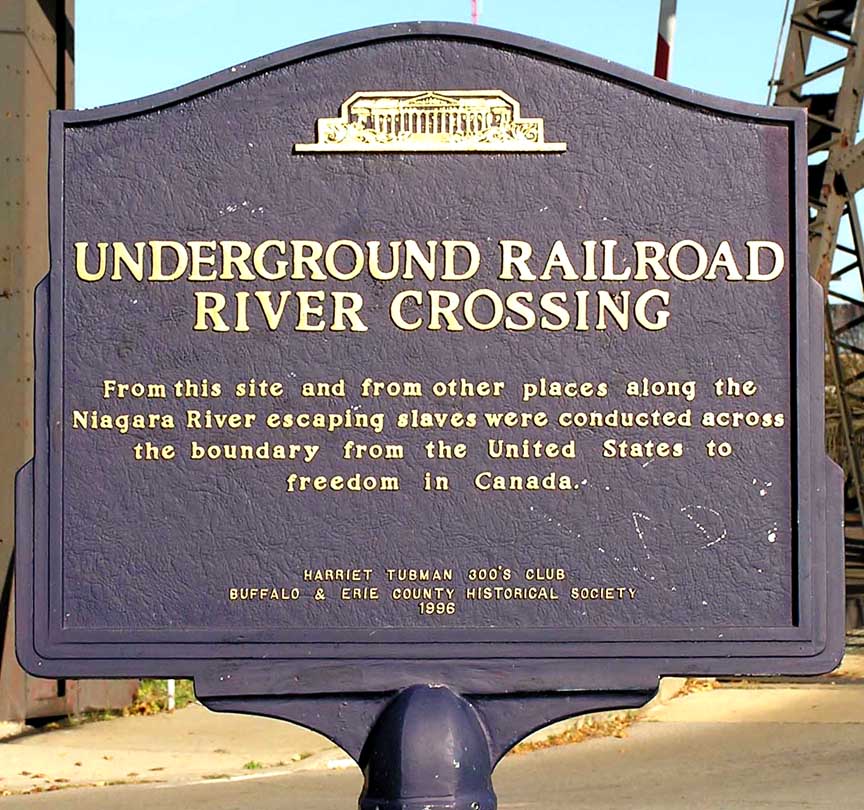
In honor of Juneteenth, I thought I’d write a little something about Buffalo’s role in abolition and the Underground Railroad.
The Erie Canal was the world’s first superhighway. Not only were goods and people moved through it, but new ideas from faraway places came along too (there were also some “services” involved, as the song “Buffalo Gals” was not originally a ditty sung by schoolchildren, but a call by sailors to the local prostitutes that they were in town looking for some post-journey entertainment. But that’s not really relevant to today’s history lesson.)
New York State abolished slavery in 1827. This led to an environment of relative freedom and safety for fugitives, so there is some speculation that many stayed in Buffalo, rather than cross the Niagara into Ontario. In 1850 President Millard Fillmore passed the Fugitive Slave Act, which his former home of Buffalo openly defied. (Fillmore has gone down as one of the worst president’s due to being on the wrong side of history on this one. He has a house in East Aurora which can be toured.)
In its’ heyday, Buffalo was not only a very wealthy place — “Millionaire’s Row” on Delaware Avenue being a testament as such — but an extremely progressive city, full of new ideas and people who were excited to express them by creating paradigms that challenged status quo worldviews. Our proximity to Canada also provided a physical, geographical connection to freedom. The combination of abolitionists in the area willing to risk their own health and safety for what was right, with the Canal delivering people to the doorstep of a new life equaled an active Underground Railroad in the region.
I encourage you to visit each of these sites for a more thorough understanding of the role Buffalo and Niagara Falls activists played to further the cause of freeing enslaved peoples.
Niagara Falls Underground Railroad Heritage Center
This is a small but worthwhile museum located between the Aquarium and Whirlpool State Park.
Their mission is, “To reveal authentic stories of Underground Railroad freedom seekers and abolitionists in Niagara Falls that inspire visitors to recognize modern injustices that stem from slavery and take action toward an equitable society.” https://www.niagarafallsundergroundrailroad.org/
Michigan Street Baptist Church
Located in the historic Michigan Street African American Heritage Corridor, this church, founded in 1836, states, “If these walls could talk, they’d tell tales of courage, perseverance, and sacrifice. From Freedom Seekers traveling along the underground railroad to activists laying the foundation for the civil rights movement, the Michigan Street Baptist Church has hosted and witnessed countless heroes united by an unwavering pursuit of progress.”
A small area within the church used to conceal runaway slaves can be viewed on the tour.
The Corridor also includes the legendary Colored Musician’s Club, where greats like Louis Armstrong and Billie Holiday once performed, along with the Edward J. Nash house. Nash was church pastor from 1892-1950’s, bringing the church to national prominence through the formation of the Niagara Movement — the precursor to the NAACP. https://www.michiganstreetbaptistchurch.org
Freedom Crossing Exhibit at the Niagara Arts and Cultural Center
Thousands of fugitive slaves, and those like Harriet Tubman who helped them, passed through the Buffalo-Niagara region on their way to Canada and freedom. The exhibit tells their story through historic photographs and contemporary artwork. Brochures and maps highlight other significant spots throughout the region, such as the Freedom Crossing monument in Lewiston, or the Canal Terminus downtown at Canalside. https://thenacc.org/about-freedom-crossing/
If you’re traveling outside of the area the National Underground Railroad Freedom Center in Cincinnati is an excellent place to visit. Exhibits include an authentic, full-scale slave cabin, and examples of modern-day slavery happening around the world today. (Don’t go on a Tuesday, I showed up there a few years ago only to find it closed, so had to stay overnight in Cincinnati to see it.) https://freedomcenter.org/
New Orleans has several plantations open for tours outside of the city, but the Whitney Plantation is the only one with an exclusive focus on the story of slavery. This is also excellent, but it can be difficult to absorb the atrocities that happened to the people who lived there, so be prepared. https://whitneyplantation.org/
-Diane D.